
How to Choose an Endocrinologist in Lahore
A practical guide to comparing endocrinology care in Lahore, from clinician fit and credentials to appointment access and follow-up.
What Does an Endocrinologist Treat? | Lahore Patient Guide

A plain-language overview of hormone-related conditions an endocrinologist may assess and when to discuss symptoms or test results with a clinician.
How to Choose an Endocrinologist in Lahore | Patient Guide

A checklist of factors to consider when reviewing an endocrinologist’s training, clinical experience, communication, and care arrangements.
HPV Vaccine in Pakistan | Cervical Cancer Prevention Guide

Complete Guide to HPV Vaccine Price in Pakistan 2025 & Cervical Cancer Prevention Prevent Cervical Cancer: HPV Vaccine Costs & Screening in Pakistan 2025 Cervical cancer remains one of the leading women’s health challenges worldwide and in Pakistan. Globally it is the fourth most common cancer among women; the World Health Organization (WHO) estimated over 600,000 new cases and 340,000 deaths in 2020. In Pakistan cervical cancer continues to cause preventable illness and death, particularly where screening and vaccination coverage are low, and awareness is limited. Human papillomavirus (HPV) infection is the principal cause, and the vast majority of cervical cancers are preventable through vaccination, regular screening and early treatment. The HPV vaccine is a powerful primary prevention tool, but concerns about availability and affordability “HPV vaccine price in Pakistan” influence uptake. Screening tests such as Pap smear and HPV DNA testing detect precancerous changes early when treatment is simple and curative. For many Pakistani families, questions about screening cost, vaccine safety, and where to seek care are central to decision-making. Prime Health Hub – Diabetes, Endocrine & Weight-loss (PHH‑DEW) in Lahore supports patients through education, affordable preventative services and referral to specialists. Our clinic works with gynaecologists and allied specialists to guide screening, vaccination and management. For specialist consultation, patients frequently consult our in-house experts such as Dr Uzma Batool (Consultant Gynaecologist) for reproductive health and screening, and our endocrine team including Dr Ali Naqvi and Dr Umme Rubab for care that intersects with metabolic health and vaccination counselling. This FAQ aims to answer common questions about cervical cancer, vaccination, costs in Pakistan, screening and next steps in a clear, evidence-based, patient-centred manner. Cervical Cancer Basics 1. What is cervical cancer? Cervical cancer is a malignant growth that begins in the cervix the lower part of the uterus usually arising from persistent HPV infection and precancerous changes. The disease typically develops slowly from precancerous lesions (dysplasia) in the cervical epithelium. Left untreated, high-grade lesions can progress to invasive cancer. Early stages often have no symptoms, which is why screening is critical. Diagnosis is made by cervical cytology (Pap test), HPV testing and biopsy when abnormalities are found. 2. How common is cervical cancer in Pakistan and worldwide? Globally it is one of the top four cancers in women; in Pakistan it remains an important public‑health problem with thousands of new cases annually and substantial mortality. WHO data (2020) show roughly 600,000 new global cases. Pakistan-specific cancer registries indicate cervical cancer among the more common female cancers, particularly where screening coverage is low. Exact counts vary by region and registry completeness, but public‑health estimates stress the need for better screening and vaccination to reduce incidence and deaths. 3. What causes cervical cancer? Persistent infection with high‑risk HPV types is the main causal factor; co‑factors like smoking, early sexual activity, multiple partners and immunosuppression increase risk. High‑risk HPV strains (notably types 16 and 18, plus others) damage cervical cells over years. Other contributors—such as tobacco use, long‑term oral contraceptive use, multiple childbirths, poor screening access and HIV infection—raise the likelihood of progression from infection to precancer and cancer. 4. What is the link between HPV and cervical cancer? High‑risk human papillomavirus (HPV) types infect cervical cells and can cause genetic changes that progress to cancer over time; HPV is responsible for nearly all cervical cancers. Infection is common and often transient; most women clear HPV naturally. Persistent infection with high‑risk strains, however, can cause cellular abnormalities. Vaccination prevents infection from the most oncogenic types, dramatically reducing precancer and cancer risk when given before exposure. 5. What are the stages of cervical cancer? Cervical cancer is staged I–IV, from disease confined to the cervix (Stage I) to spread to distant organs (Stage IV); staging guides treatment and prognosis. Early stages (I–II) are often treatable with surgery, radiotherapy or combined approaches. Locally advanced disease (stage III) often requires chemoradiotherapy. Metastatic disease (stage IV) needs systemic therapy and palliative care. Accurate staging uses clinical exam, imaging and pathology. Symptoms, Risk Factors & Early Signs 6. What are the early symptoms of cervical cancer? Early cervical cancer may be asymptomatic; when present, symptoms include abnormal vaginal bleeding, intermenstrual or post‑coital bleeding, unusual discharge and pelvic pain. Because early disease can be silent, routine screening is essential. Any new abnormal bleeding especially after intercourse or in postmenopausal women merits prompt evaluation. Persistent malodorous discharge, pelvic pain or weight loss require investigation for advanced disease or other causes. 7. Who is most at risk of developing cervical cancer? Women with persistent high‑risk HPV infection, early sexual debut, multiple sexual partners, smoking, HIV/immunosuppression and lack of screening are at higher risk. Socioeconomic factors and limited access to screening amplify risk in many Pakistani communities. Women living with HIV have a substantially higher risk of HPV persistence and progression. Regular screening and vaccination reduce risk across all groups. 8. Can cervical cancer be prevented? Yes — prevention is highly achievable through HPV vaccination, regular screening (Pap smear/HPV testing) and treatment of precancerous lesions. Primary prevention (HPV vaccination) and secondary prevention (screening and treatment of precancer) together can reduce incidence dramatically. WHO’s elimination strategy targets high vaccination and screening coverage to bring cervical cancer toward elimination as a public‑health problem. HPV & The HPV Vaccine 9. What is HPV and how is it transmitted? HPV (human papillomavirus) is a common sexually transmitted virus with many types; some high‑risk types can cause cervical and other cancers. HPV spreads primarily through sexual contact, skin‑to‑skin genital contact and rarely via non‑sexual routes. Many infections are asymptomatic. Condoms reduce but do not eliminate transmission risk. Vaccination before sexual debut is most protective. 10. How does the HPV vaccine prevent cervical cancer? The vaccine elicits immunity against high‑risk HPV types, preventing infection and subsequent development of precancerous cervical lesions and cancer. Current vaccines (bivalent, quadrivalent, nonavalent) protect against HPV types responsible for the majority of cervical cancers. When administered before exposure, vaccination reduces the incidence of high‑grade cervical intraepithelial neoplasia, the precursor to invasive
Diabetes and Endocrine Treatment in Lahore | PHH-DEW
Endocrine & Diabetes Care in Lahore Led by FRCP London Specialist If you’re searching for the best endocrinologist for diabetes treatment in Lahore, you likely want two things: proven medical expertise and clear, compassionate care that helps you stay healthy long term. At Prime Health Hub – DEW (PHH-DEW) in DHA Phase 6, Lahore, we deliver both led by Dr. Ali Raza Naqvi, FRCP London, a UK-trained consultant endocrinologist with 20+ years of experience, specialist MRCP/CCT training from London, and 17+ peer-reviewed publications. He is currently Consultant Physician & Endocrinologist at PKLI Research Center, Lahore (since Oct 2022) and a GMC-recognized clinical & educational supervisor. This guide explains how we diagnose, treat, and prevent complications of type 1, type 2, and gestational diabetes, what makes our treatment approach different, and why Dr. Naqvi’s international credentials directly translate into safer care and better outcomes for patients across DHA, Gulberg, Model Town, and Johar Town and even for those comparing options in Karachi or Islamabad. By the end, you’ll know exactly what to do next to take control of your diabetes and how to book a same-day or next-day consult at PHH-DEW. Book Your Consultation: +92 329 990 7779 | Online appointment (PHH-DEW Contact) | Visit us in DHA Phase 6, Lahore (Google Maps) Why Choose Diabetes Treatment in Lahore at PHH-DEW? Choosing diabetes care in Lahore shouldn’t mean compromising on standards. At PHH-DEW, we align our protocols with ADA (American Diabetes Association) Standards of Care 2025 and NICE (UK) guidance, then tailor them to the Pakistani healthcare context. Diabetes Journals Evidence-based care: Medication and lifestyle plans are built from the latest ADA/NICE guidance (e.g., when to use SGLT2 inhibitors or GLP-1 receptor agonists for heart and kidney protection in type 2 diabetes). Diabetes Journals Integrated services: On-site diagnostics, medication counseling, complication screening, and weight-management support so you avoid fragmented care. Continuity & follow-up: Clear targets, regular reviews, and proactive complication screening to keep you on track. Dr. Naqvi’s International Expertise Dr. Ali Raza Naqvi, FRCP London trained and practiced across top UK hospitals for 15+ years including Imperial Healthcare NHS Trust, London (Specialist Registrar 2013–2018) before returning to Pakistan in 2022. His trajectory includes Portsmouth Hospital NHS Trust, Glasgow Royal Infirmary, Wrexham Maelor, Trafford General (Manchester), UK consultant posts (2018–2022), and recently with PKLI RC, Lahore. This history ensures you receive UK-standard endocrine care, adapted to local realities and access. Advanced Treatment Protocols PHH-DEW follows ADA 2025 and NICE NG28 algorithms to personalize therapy: starting with lifestyle and metformin (when appropriate), then SGLT2 inhibitors and GLP-1 RAs where indicated for cardio-renal benefits, and insulin when needed with modern devices and injection education to reduce hypoglycemia risk. Diabetes Journals Comprehensive Diabetes Overview Understanding Diabetes in Simple Terms Diabetes is a condition where glucose (sugar) builds up in your blood because your body does not make enough insulin or can’t use it properly. Over time, high glucose damages blood vessels and nerves, leading to complications in the heart, kidneys, eyes, and feet. Diagnosis relies on tests such as A1c, fasting plasma glucose (FPG), oral glucose tolerance test (OGTT), and random glucose. The ADA and NIDDK provide clear thresholds for each test. NIDDK A1c ≥ 6.5% (on a certified test) suggests diabetes; 5.7–6.4% indicates prediabetes. Diabetes.org FPG ≥ 126 mg/dL or a 2-hour OGTT ≥ 200 mg/dL also meet diabetes criteria. NIDDK Latest Treatment Approaches (2025) Modern diabetes care goes beyond “sugar control.” For type 2 diabetes, the ADA 2025 and NICE NG28 emphasize cardiovascular-renal protection when choosing medications: SGLT2 inhibitors (e.g., empagliflozin class) help reduce heart failure hospitalization and slow kidney disease progression. GLP-1 receptor agonists support weight loss and reduce major adverse cardiovascular events in high-risk patients. Diabetes Journals For type 1 diabetes, structured education, appropriate insulin regimens, and continuous monitoring (CGM/flash) are standard of care. For gestational diabetes, timing of diagnosis and treatment protects both mother and baby. All are covered comprehensively in ADA 2025. Diabetes Professionals Prevention Strategies You Can Start Today Maintain a healthy weight; even 5–7% loss improves insulin sensitivity. Aim for 150 minutes/week of moderate activity (e.g., brisk walking). Choose a low-GI, fiber-rich diet and keep portions consistent. Get regular screening for prediabetes if you’re at risk (family history, overweight, PCOS, prior GDM). Guidance: ADA 2025, NIDDK. Diabetes Professionals Explore our services: Diabetes Care at PHH-DEW | Weight Management Expert Treatment at PHH-DEW Clinic Diagnostic Capabilities At PHH-DEW (DHA Phase 6), we provide or coordinate: Laboratory testing: A1c, FPG, OGTT, lipid profile, kidney function, urine albumin-creatinine ratio. Thyroid & adrenal panels when relevant (autoimmunity is common alongside type 1 diabetes). Complication screening: retinal (ophthalmology referral), neuropathy assessment, foot checks, and cardiovascular risk stratification aligned with ADA/NICE intervals. Diabetes Professionals+1 Treatment Options Available Lifestyle & Medical Nutrition Therapy (MNT): culturally attuned meal plans for Lahore’s cuisine. Pharmacotherapy: Metformin where appropriate. SGLT2 inhibitors and GLP-1 RAs for eligible patients (especially with heart/kidney risks). Insulin therapy when required, with patient-friendly teaching to improve safety and confidence. Technology support: glucose meters, flash/CGM guidance, and data-driven dose adjustments. Weight-management integration: combining MNT, exercise plans, and (where indicated) anti-obesity medications or bariatric referrals, in line with ADA 2025 Section 8. Diabetes Professionals Follow-up Care Protocol You’ll leave with a personalized care plan: target A1c and blood pressure, medication schedule, hypoglycemia prevention plan, lab follow-up dates, and complication-screening reminders. We review progress every 4–12 weeks depending on your plan and adjust treatment using ADA/NICE pathways. Diabetes Journals Meet your specialist: Dr. Ali Raza Naqvi (Profile)Clinic: PHH-DEW, DHA Phase 6, Lahore | Contact & Booking Why Dr. Naqvi’s Expertise Matters UK Royal College Training Advantage Being FRCP (London) is among the highest professional distinctions in UK medicine. Dr. Naqvi also holds MRCP/CCT (Endocrinology & Diabetes) which means he completed formal UK specialist training and independent consultant practice before returning to Lahore. Patients benefit from international best practices, audit culture, and safety protocols that are often under-emphasized in routine care. Research Publications Impact Dr. Naqvi’s research mindset strengthens real-world care. Two examples often cited in
Semaglutide for Weight Management: Evidence and Safety
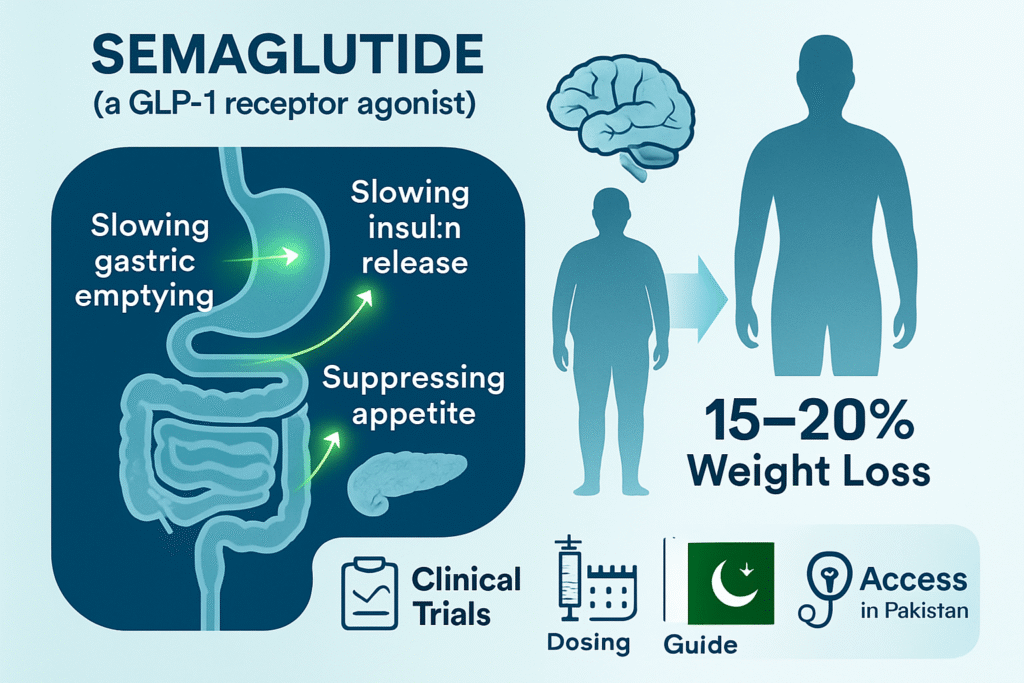
A plain-language summary of semaglutide research, its limits, and the questions to discuss before considering treatment.
Diabetes, Thyroid and Weight Care in Lahore | PHH-DEW

An overview of diabetes, thyroid and weight care in Lahore, plus questions to ask when comparing endocrine services and planning a visit.
Ozempic in Pakistan: Price, Access and Safety Questions

A practical guide to checking Ozempic price and availability in Pakistan, understanding product details, and discussing safety with a clinician.
Endocrinologist Meaning in Urdu: A Simple Guide

A plain-language guide to the Urdu meaning of endocrinologist, the glands and hormones involved, and the conditions this specialist may assess.